Collaborative Research by CSE Graduate Student Wins MERCon 2026 Best Paper Award for Cross-Lingual Speech Recognition Research
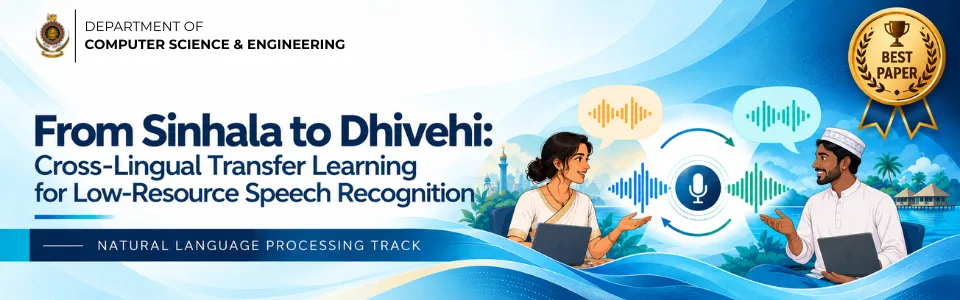
Nevidu Jayatilleke, an MSc student in the Department of Computer Science & Engineering, University of Moratuwa, has won the Best Paper Award in the Natural Language Processing track at MERCon 2026, in collaboration with Lukmal Ilyas, an undergraduate from the School of Computing at the Informatics Institute of Technology (IIT). Their paper, “From Sinhala to Dhivehi: Cross-Lingual Transfer Learning for Low-Resource Speech Recognition,” tackles a problem facing thousands of the world’s languages: how to build usable automatic speech recognition (ASR) when only a small amount of transcribed audio exists.
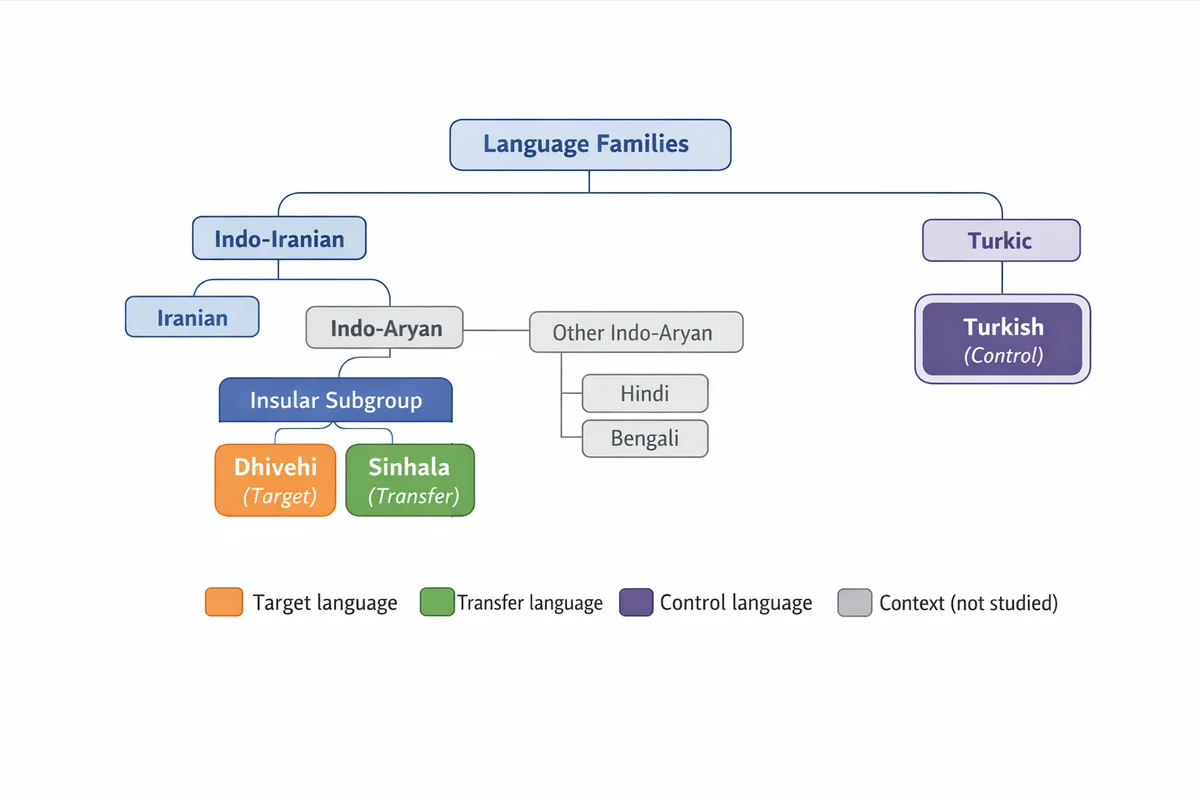
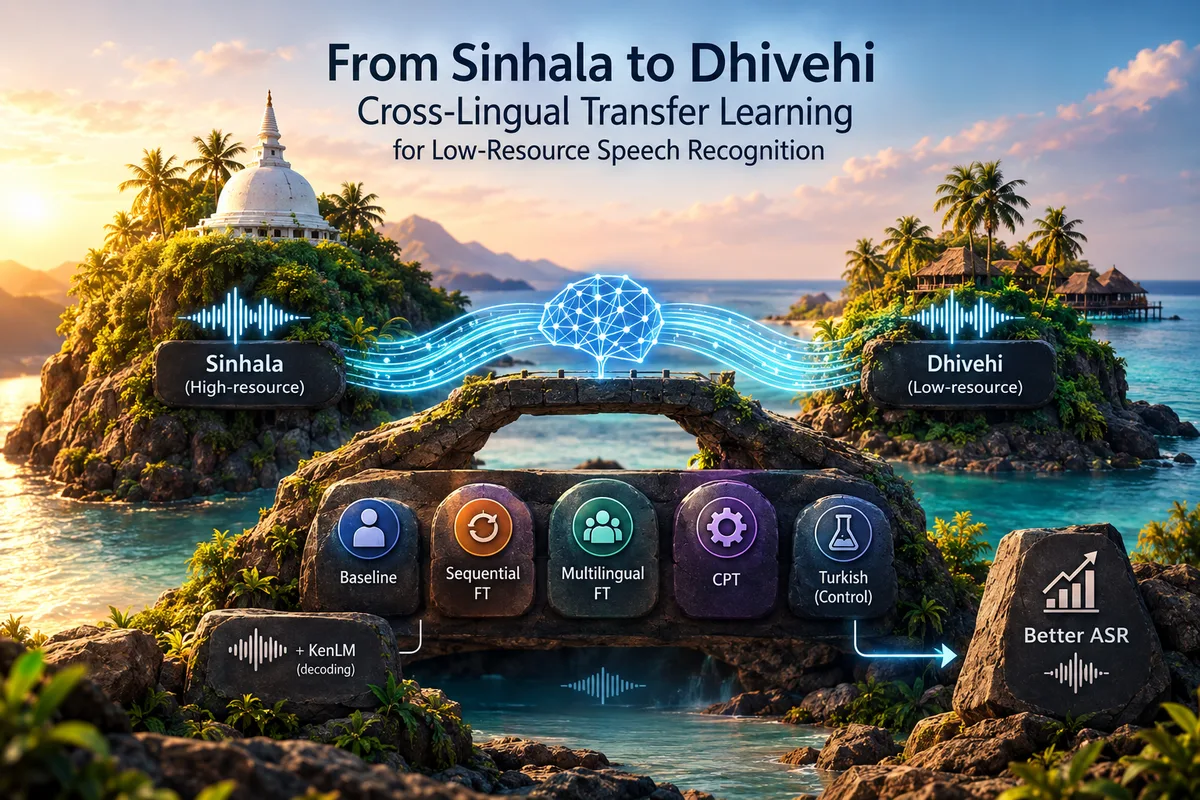
The team, consisting of Nevidu Jayatilleke and Lukmal Ilyas, tested whether Sinhala, a linguistically related and relatively well-resourced language, could improve automatic speech recognition for Dhivehi, the national language of the Maldives. Dhivehi remains highly under-resourced for ASR, with only around 61 hours of audio available through Mozilla Common Voice, compared to roughly 220 hours of openly available Sinhala speech.
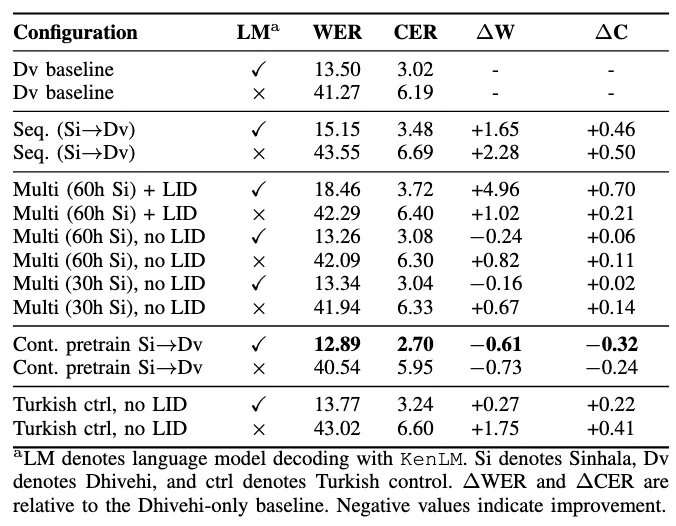
The team ran seventeen experiments across five transfer learning strategies, including sequential fine-tuning, multilingual fine-tuning, and Continual Pre-Training (CPT) of the speech encoder on Sinhala before fine-tuning on Dhivehi. A Turkish control experiment, using an unrelated language in place of Sinhala, confirmed that the gains came from genuine linguistic relatedness rather than simply having more training data. The strongest system, CPT combined with KenLM language model decoding, achieved 12.89% Word Error Rate (WER) and 2.70% Character Error Rate (CER), improving on the Dhivehi-only baseline of 13.50% WER and 3.02% CER.
A notable finding was that explicitly telling the model which language it was hearing, through language identification tokens, hurt performance rather than helping it. The team suggests that in this low-resource, two-language setting, explicit language conditioning introduces harmful separation in the decoder rather than useful disambiguation. Enabling KenLM decoding also proved to be the single largest factor in the study, cutting WER by 24 to 29 absolute percentage points across every configuration tested.
The team's Dhivehi-only baseline of 13.50% WER already exceeded the strongest previously published Dhivehi ASR result of 14.26% WER, and their best transfer result of 12.89% WER pushes that further. The paper, along with the experiment scripts and code behind the study, is publicly available to support further research.
Paper – https://ieeexplore.ieee.org/document/11691501
Preprint – https://arxiv.org/abs/2607.06289
GitHub – https://github.com/lukmalilyas/From-Sinhala-to-Dhivehi-ASR