CSE Team BioNeuxus Received Best Presenter Award at SLAAI-ICAI 2026

[20th November 2026, at University of Sri Jayewardenepura]
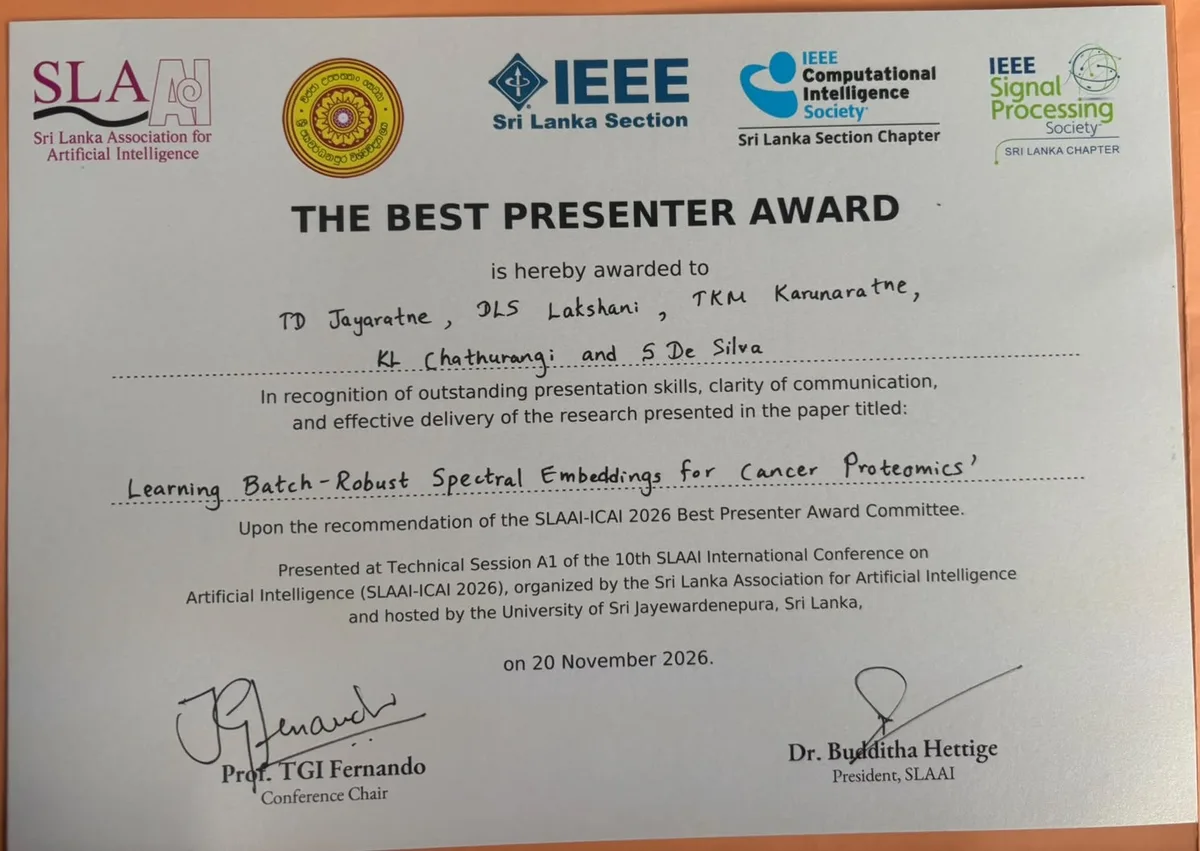
The Department of Computer Science and Engineering, University of Moratuwa, is proud to announce that Team BioNeuxus was awarded the Best Presenter Award at the 10th SLAAI International Conference on Artificial Intelligence, in “Core AI and Machine Learning” track- A1 Session, for their publication titled “Learning Batch-Robust Spectral Embeddings for Cancer Proteomics”.
The team consists of Ms. Subhagya Lakshani, Ms. Madhuni Karunaratne, Ms. Chathurangi Liyanage, Ms. Tharani Jayaratne from Batch 22, supervised by Prof. Dulani Meedeniya and Dr. Senuri De Silva. The Department congratulates them on achieving this recognition and commends their continued dedication to advancing AI for societal benefit!
Abstract—
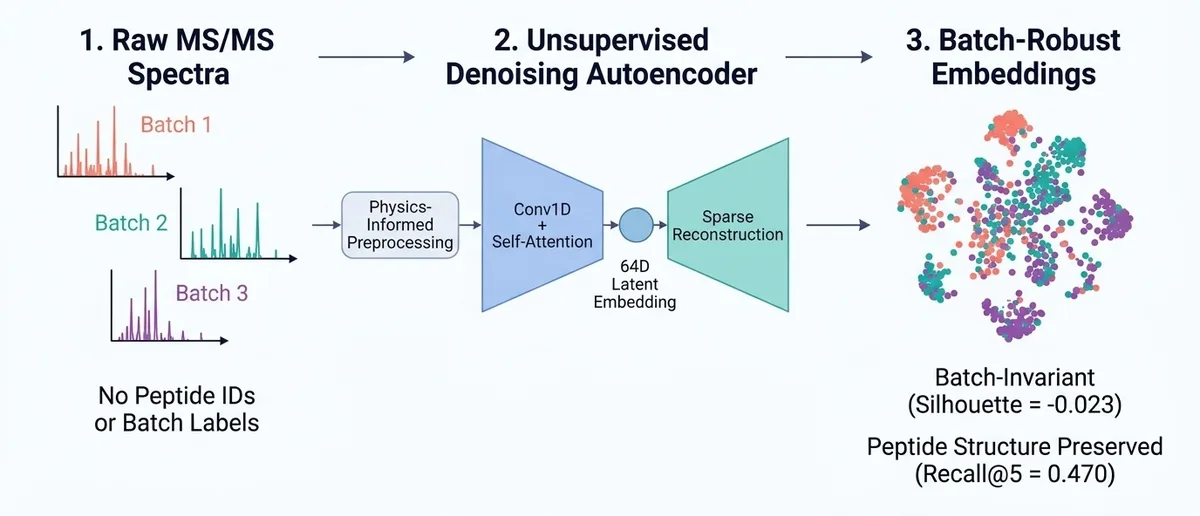
Mass spectrometry is a central technology for largescale proteomics, generating hundreds of thousands of fragmentation spectra in modern cancer studies. However, spectra acquired across multiple mass spectrometry (MS/MS) runs contain technical variation arising from differences in sample preparation, instrumentation, and acquisition methods. These batch effects can obscure meaningful spectral relationships and compromise downstream analyses. Existing batch-correction methods are primarily designed for quantitative protein measurements and typically require peptide or protein identifications, limiting their application to the large fraction of unidentified MS/MS spectra. In this work, we propose an unsupervised denoising autoencoder that learns compact spectral representations directly from MS/MS data without requiring peptide identifications or batch labels. The framework integrates physics-informed spectral preprocessing with a convolutional self-attention architecture and a sparse-aware reconstruction objective to learn denoised embeddings. Evaluated on 399,469 MS/MS spectra from a publicly available breast cancer cohort, the learned embeddings exhibited negligible separation by acquisition batch (silhouette score = −0.0231) while maintaining meaningful spectral neighbourhoods (Recall@5 = 0.470). These results demonstrate that unsupervised representation learning can suppress acquisition-related batch variation directly at the spectrum level without dedicated batch correction procedures while preserving biologically meaningful spectral structure for downstream proteomic analysis.