CSE Researchers Release SinLlama: The First Large Language Model for Sinhala
A research team from the Department of Computer Science & Engineering, University of Moratuwa, has achieved a significant milestone in Artificial Intelligence (AI) and Natural Language Processing (NLP) for Sri Lanka by developing SinLlama, the first open-source Large Language Model (LLM) built specifically to support Sinhala.
Commercial LLMs such as ChatGPT have revolutionised how people interact with AI worldwide. However, these models typically perform best in high-resource languages (HRL) such as English, Chinese, or Spanish. While some support low-resource languages (LRL) such as Sinhala to an extent, it is not sufficient. Additionally, the full function of these tools is not free. On the other hand, fully open source solutions such as Llama have even worse performance for LRLs. Meaning, overall, advanced AI tools simply don’t properly “understand” the Sinhala language yet.
Sinhala, spoken by over 20 million people, has historically been underrepresented in AI systems. While past efforts introduced word embeddings and smaller models for Sinhala, no modern LLMs had been explicitly trained for the language. This gap has limited the availability of advanced digital tools for Sinhala speakers, contributing to a growing digital divide. SinLlama aims to change that.
The UoM research team, of H.W.K. Aravinda, Rashad Sirajudeen, Samith Karunathilake, and Nisansa de Silva, collaborated with international researchers, Surangika Ranathunga (New Zealand), Rishemjit Kaur (India) and Arshdeep Singh Bhankhar (India) to address this issue.
What is SinLlama?
Their approach involved extending Meta’s Llama-3–8B model (an advanced multilingual LLM) with Sinhala-specific vocabulary and further training it on more than 10 million Sinhala sentences. The UoM researchers adapted it in two key ways: Tokeniser Extension and Continual Pretraining.
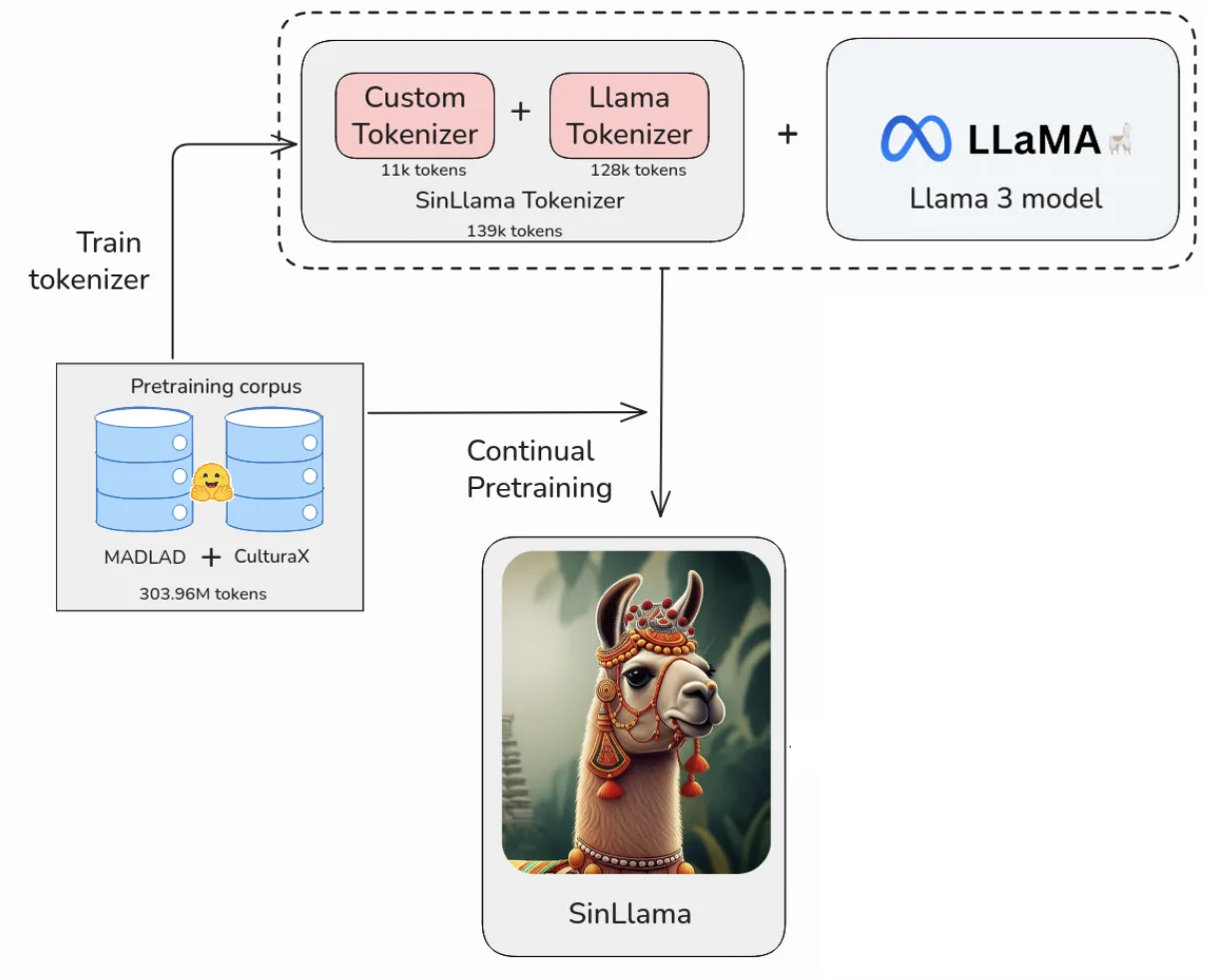
A tokenizer splits text into smaller units, called tokens, which an LLM uses to understand and process language. The original Llama tokenizer had difficulty with Sinhala, often breaking words into awkward fragments. By Tokeniser Extension achieved through introducing Sinhala-specific tokens, the researchers enabled the model to recognize and handle Sinhala words more naturally.
Rather than building a model from the ground up, Continual Pretraining takes an already-trained model and further trains it with additional data. Here, the team fed the model 10 million Sinhala sentences (about 300 million tokens), allowing it to develop a much richer understanding of Sinhala grammar, vocabulary, and writing style.
Outperforming Sinhala Benchmarks
To test its performance, the team compared SinLlama against the original LLaMA-3. They fine-tuned (or “specialised”) both models for three Sinhala-language tasks:
|
|
 |
 |
|
Writing-style classification (academic, creative, news, blog)
|
News categorisation (e.g., politics, business, technology, sports, entertainment) |
Sentiment analysis (positive, negative, neutral) |

The results were striking: fine-tuned SinLlama consistently outperformed both base and instruction-tuned versions of LLaMA-3 across all benchmarks. For example, in news categorisation, SinLlama achieved an F1-score (a measure of correctness) of over 86%, compared to just 61% for the fine-tuned LLaMA-3 base model. These are not abstract research puzzles; they are the building blocks of applied Sinhala NLP systems for industry.
Why This Matters
According to the researchers, excluding smaller languages risks widening the digital divide, where communities with fewer resources struggle to access modern AI technologies. By releasing SinLlama openly to the global research community, the team ensures that developers, businesses, and academics can now build Sinhala-capable applications—from smarter chatbots to advanced content analysis systems—without being held back by language limitations.
SinLlama is more than a student project. It signals that Sri Lankan researchers and engineers can build frontier-level AI systems for their own language instead of waiting for global tech giants.
If supported correctly, SinLlama can evolve from a research prototype into the foundation of a Sri Lankan AI ecosystem, serving 20 million Sinhala speakers with tools designed in their own country, in their own language.
But why is this Being Built When We have ChatGPT, etc?
A natural question arises: if powerful systems like ChatGPT or Gemini already exist, why invest time and resources into building a Sinhala-specific model?
The answer lies in language representation and accessibility. As mentioned earlier, global AI models are trained primarily on high-resource languages like English, Chinese, or Spanish. While they advertise “multilingual” support, their performance in low-resource languages such as Sinhala is weak. Words get tokenised awkwardly, grammar is mishandled, and the output often feels unnatural or error-prone.
It is important to note that the full power of tools like ChatGPT is not freely accessible. The free tier that is available to you is just a fraction of what it really can do. Further, relying too heavily on AI systems hosted abroad can leave Sri Lanka dependent on external providers rather than building its own digital capabilities.
SinLlama addresses this gap by being deliberately built with Sinhala at its core. Unlike ChatGPT, which is benchmarked on reasoning across many domains, SinLlama is judged on whether it can actually understand Sinhala text and perform practical tasks such as classifying news, analysing sentiment, or identifying writing styles.
This narrower focus is not a limitation — it is the foundation. Before Sinhala AI systems can provide sophisticated dialogue, reasoning, or creative outputs, they must first achieve reliable comprehension of the language itself. SinLlama is that first critical step.
In short, ChatGPT is a global generalist, while SinLlama is a Sinhala specialist — and specialists are exactly what’s needed to ensure Sri Lanka’s languages are not left behind in the AI era.
|
Feature / Concern |
ChatGPT / Gemini |
SinLlama |
|
Multilingual support advertised |
✅ |
✅ |
|
Freely accessible with full power |
❌ |
✅ |
|
Benchmarked on Sinhala comprehension tasks |
❌ |
✅ |
|
Designed as a Sinhala specialist |
❌ |
✅ |
Looking Ahead
The team plans to explore additional fine-tuning strategies and preference optimisation techniques to make SinLlama even more powerful in real-world use cases. They hope this project will inspire similar efforts for other low-resource languages, giving more communities a voice in the age of AI.
The results so far are very promising, but the journey has only begun. To make SinLlama truly world-class, several investments are needed:
- Instruction datasets: Very importantly, SinLlama is a base model. It is not a chat model. It understands Sinhala, but if you want to chat with it like you do with ChatGPT, it has to be further fine-tuned with carefully curated, diverse instruction data on trillions of tokens tailored for real-world tasks.
- More diverse benchmarks: Beyond classification, Sinhala models need evaluation on tasks like question answering, translation, and dialogue.
- Deployment pathways: APIs, embeddings, and efficient inference engines will be needed to bring SinLlama into Sri Lankan products.
- Human preference tuning: Sinhala-specific reinforcement learning from human feedback (RLHF) could make the model more user-aligned.
- Cross-lingual integration: Seamless Sinhala–Tamil–English transfer is essential, reflecting Sri Lanka’s trilingual context.
Concluding Thoughts
By releasing SinLlama and the 10 million Sinhala sentence dataset openly, the UoM team has highlighted their commitment to linguistic inclusion through openness and free access for all, so that the global community may build on their work, ensuring that Sinhala has a place in the global AI conversation. The responsibility now lies with:
- Industry – Commercialise SinLlama through APIs, embeddings, and efficient deployment, turning it into usable products and services for Sinhala speakers.
- Policy makers – Support Sinhala digital infrastructure and enable Sinhala-Tamil-English integration to strengthen AI accessibility and inclusivity in Sri Lanka, to encourage Sinhala-language digital infrastructure.
- Academia – Advance SinLlama with instruction datasets, diverse benchmarks, and RLHF, moving beyond publications toward real-world applications.
Congratulations to our CSE researchers for spearheading this landmark achievement and putting Sinhala on the global AI map!