
Bio-Health Informatics
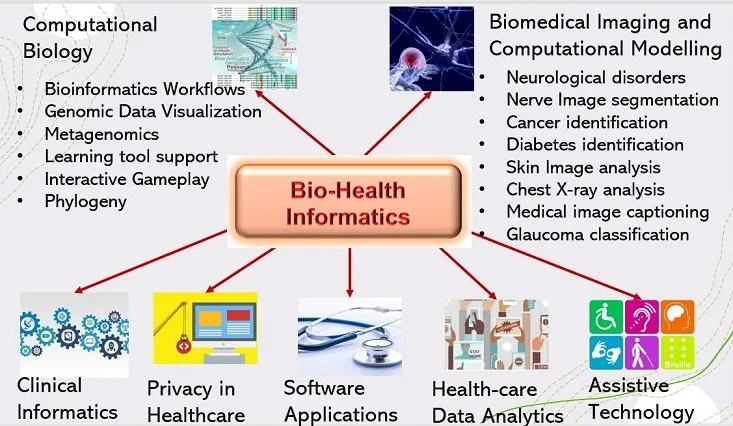
The computational biology theme combines the computing and bioinformatics aspects for better data analysis and learner support. Biomedical data processing and classification facilitates the diagnosis process of different diseases and disorders. Mainly, neurological, diabetic and cancer diseases are considered in this theme. The theme of clinical informatics addresses the related aspects to maintain a better clinical practice. Another possible research theme is the aspects related to the privacy and security of healthcare data.
These research projects explore a range of techniques and tools in the considered areas and use the knowledge of image processing, information management, learning models, clinical terminologies and verification aspects. The research in Bio-Health Informatics dedicates to construct the state-of-the art, intelligent, accurate and reliable computational modelling for the decision-making process in bioinformatics, medicine, healthcare and social-care.
Biomedical Models and Applications
Bioinformatics is focused on deriving biological understanding from large amounts of data with specialized skills and computational tools. Bioinformatics research continues to advance at an increasing scale with the help of techniques such as next-generation sequencing and the availability of tool support to automate bioinformatics processes. With this growth, a large amount of biological data gets accumulated at an unprecedented rate, demanding high-performance and high-throughput computing technologies for processing such datasets.
Biomedical Imaging and Computational Modelling
Psychophysiological chronic disorders lead to both physical disorders and emotional factors such as anxiety and stress. This requires the patients to live under medical treatments in their lives. Most of them have a genetic influence and observable in children at an early age. Therefore, the early identification of a disorder is important to reduce the negative consequences of adulthood. The machine learning and deep learning techniques have been actively applied in recent years based on neuroimaging inputs such as electroencephalogram, magnetic resonance imaging to find feasible computational solutions. However, the recent studies are lacking the support for multiple disorders rather focusing only on single disorder though there are commonalities among many of the psychophysiological chronic disorders. Thus, a generic neuroscience decision support system framework with the aid of learning models can be designed and implemented to identify the disorders when neuroimaging inputs are given.
Assistive Technology for Special Needs
Visual impairment can affect a student’s ability to learn since their concept development when interacting with educational material is being limited. Learning activities based on images and visually rich content are mainstream learning methods, where facilitating students with visual impairments for engaged learning can be challenging. For comic books, which have shown promising results in engaged student learning, this problem is more severe. To overcome this challenge, this research presents a novel voice synthesised learning method to reduce the gap between the learning experience of a student with visual impairments compared to a mainstream learning activity. Utilising comic books, the proposed technique and the tool developed extracts semantic content, stores them in a database, and generates an audio stream in multiple languages on the user’s demand. To assess the usability of the system, a survey for a selected set of students with visual impairments was carried out. Furthermore, a concept-mapping approach was used to analyse the feedback given through the open-ended questions. From the analysis, key concepts with an emphasis on positive emotions, willingness to try again, and features to be improved, were identified.
Director:
Prof. D. A. Meedeniya (Google Scholar)
Staff Members:
Prof. Indika Perera (Google Scholar)
Dr. Charith Chitraranjan (Google Scholar)
Dr. Thanuja Ambegoda (Google Scholar)
Dr. Buddhika Karunarathne (Google Scholar)
YouTube Channel: Bio-Health Informatics Lab - CSE - UOM
For more details, please visit our website.