

Eco-Sustainable Informatics
RESEARCH AREAS:
- Smart City Management
- Smart Agriculture
- Disaster Management
- Precipitation Nowcasting
- Forest Observatory
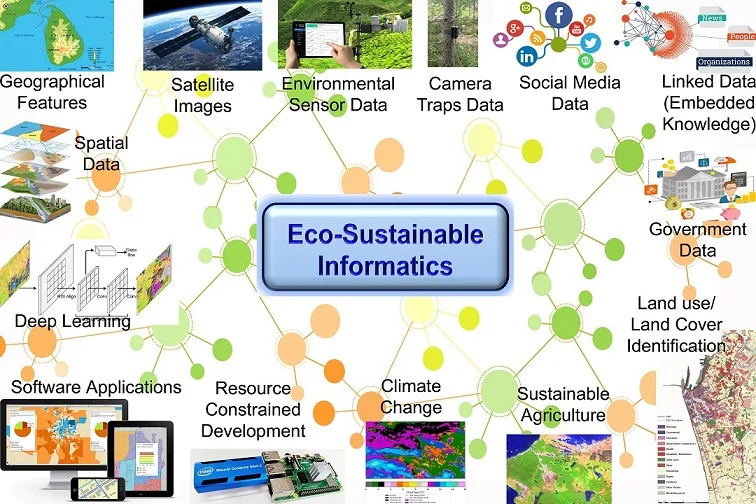
Smart city management involves the use of advanced technologies and data-driven approaches to optimize city operations and services, while promoting sustainable development and environmental protection. Smart city management with sustainable informatics can help cities become more efficient, livable, and environmentally sustainable, promoting economic growth and enhancing quality of life for residents.
Some examples of smart city management with sustainable informatics include:
- Land Cover and Land Usage
- Remote Sensing
- GIS Mapping
- Urban Forest Monitoring
- Smart Parking
- Green Infrastructure
- Smart Energy Management
- Smart Transportation
- Smart Waste Management
- Smart Water Management
- Public Services
Smart Agriculture involves the use of advanced technologies to agriculture in order to increase efficiency, reduce waste, and promote sustainable practices. It uses sensors, satellite images, drone images, and other technologies to collect data on crop growth, soil moisture, and weather patterns to optimize farming practices and reduce the environmental impact of agriculture. Smart agriculture can play an important role in promoting sustainability and reducing the environmental impact of agriculture. By using technology to optimize resource use and reduce waste, farmers can help protect the environment while also increasing productivity and profitability.
Disaster management: This involves smart applications for environmental sustainability refers to the use of advanced technologies and data-driven approaches to prepare for, respond to, and recover from disasters while minimizing the environmental impact.
Precipitation nowcasting: This promotes sustainable environments by providing accurate and timely information on precipitation patterns, allowing for better management of natural resources such as water and land.
Forest observatory: This involves collection of data on forest ecosystems, including environmental conditions, forest structure, biodiversity, and other relevant information. Smart applications can be integrated into the forest observatory to enhance the accuracy and efficiency of data collection and analysis. Some examples of smart applications for a forest observatory include using sensors, remote sensing, machine learning, and geospatial data to monitor forest health, detect and predict forest fires, protect forests from deforestation and other human activities, monitor wildlife populations, and optimize forest management practices. By using smart applications, a forest observatory can provide valuable insights into the health and well-being of forest ecosystems, helping to inform management decisions and support conservation efforts.
Projects
Customer Gaze Estimation in Retail Using Deep Learning
Measuring Road Roughness and Detecting Road Anomalies Using Crowd Sensed Smartphone Sensor Data
Automated Vehicle Parking Occupancy Detection in Real Time
Director:
Prof. D. Meedeniya (Google Scholar)
Staff Members:
Prof. I. Perera (Google Scholar)
Dr. C. Chitraranjan (Google Scholar)
Dr. K. Gunasekera
Dr. A. Wijayasiri (Google Scholar)
Dr. T. Ambegoda (Google Scholar)
For more details, please visit our website